





SanDisk did not rise 2,969% because the world suddenly bought more flash memory. It rose because the world paid roughly three times as much for very nearly the same amount of it. That distinction is the whole article, and it is not a matter of interpretation: SanDisk’s own annual report says total products sold grew “by mid-teens percent on an exabyte basis” in fiscal 2026, while revenue grew 175%. Shares closed at $1,536.87 on 1 September 2026, against a 52-week low of $50.07 and a high of $2,354.39 — meaning the stock is simultaneously up 2,969% from its floor and down 34.7% from its ceiling. Anyone hunting the next SanDisk is really hunting the next repricing of a capped commodity, not the next great growth company. Those are different screens, and only one of them works.
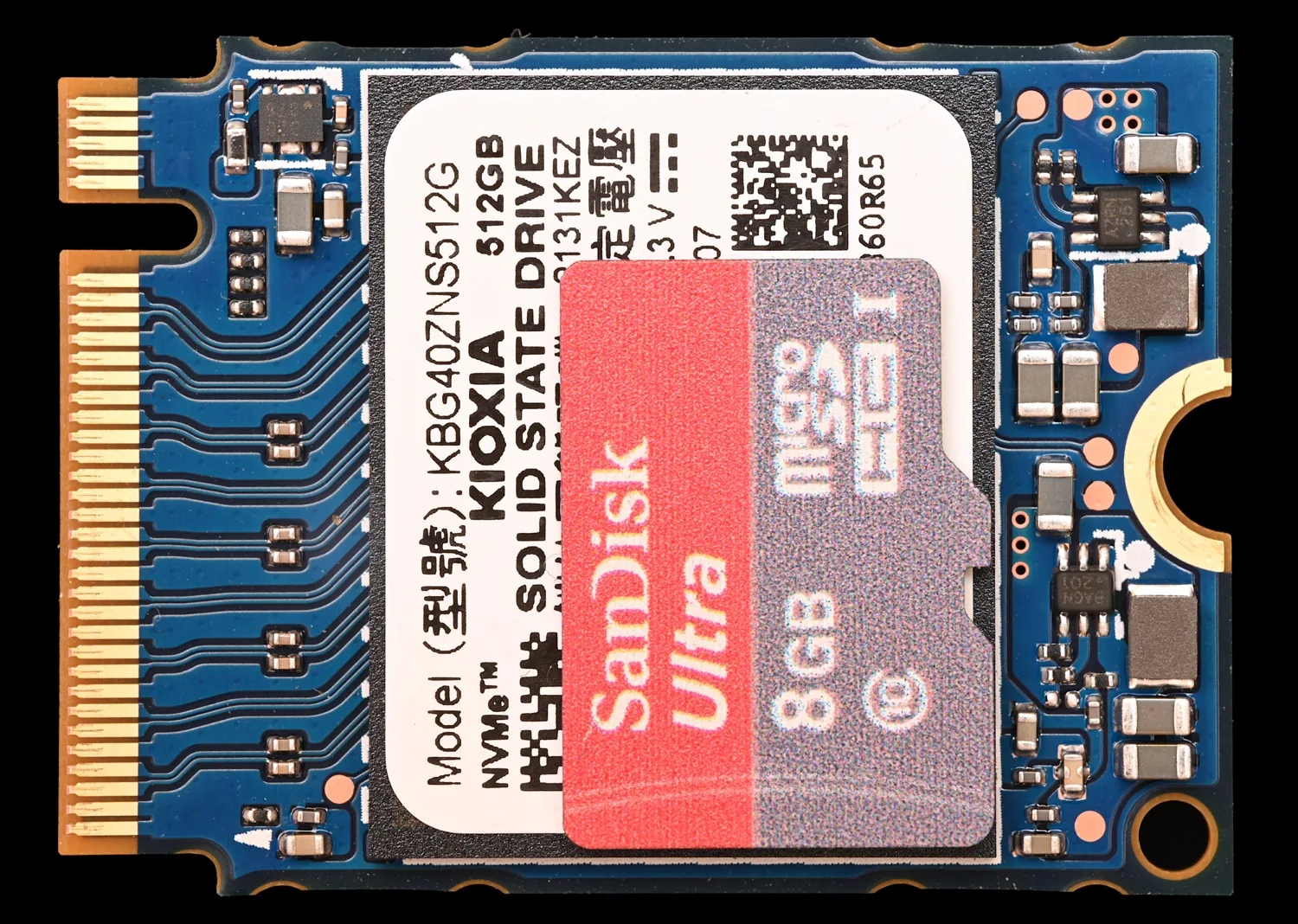
Here is the part that inverts the usual “picks and shovels” list. SanDisk earned an 84.6% gross margin in its fourth quarter by not building anything. Capital expenditure for the entire fiscal year was $177 million — nine-tenths of one per cent of revenue — because SanDisk does not own its fabs outright. It holds 49.9% of Flash Ventures, the joint venture with Kioxia that operates eight plants in Japan. It physically could not expand into the shortage, so the shortage expanded its margin instead. The screening criterion that actually mattered was therefore low capital spending, not high. Every list that goes looking for the company best positioned to build into a boom is looking for the company most likely to end it.
Key facts
- SanDisk (SNDK) closed at $1,536.87 on 1 September 2026 — 2,969% above its 52-week low of $50.07 and 34.7% below its high of $2,354.39 — stockanalysis.com, 1 September 2026
- Fiscal 2026 revenue $20.25 billion, up 175%; GAAP net income $11.43 billion against a $1.64 billion loss a year earlier — SanDisk Form 8-K, 5 August 2026
- Bits shipped grew only “mid-teens percent on an exabyte basis”, while revenue per gigabyte rose roughly 180% in Edge and 150% in Datacenter — SanDisk Form 10-K, 17 August 2026
- Gross margin moved from 26.2% to 84.6% in four quarters; operating income went from $18 million to $7,037 million — SanDisk Form 8-K, 5 August 2026
- Capital spending for the whole year: $177 million, or 0.9% of revenue — SanDisk Form 10-K, 17 August 2026
- SanDisk holds 49.9% of Flash Ventures, the Kioxia joint venture running six fabs in Yokkaichi and two in Kitakami — SanDisk Form 10-K, 17 August 2026
- Just 146.42 million shares outstanding, and a forward P/E of 7.18 against a trailing 20.84 — stockanalysis.com, 1 September 2026
What actually happened to SanDisk
SanDisk completed its separation from Western Digital on 21 February 2025 and began life as a standalone Nasdaq company with a carve-out balance sheet, a commodity product and no obvious reason for anyone to own it. In the quarter ended 28 March 2025 it lost money at the operating line, on a 22.5% gross margin. Eighteen months later it reported a quarter with $8.97 billion of revenue and $6.90 billion of net income.
The mechanism is stated plainly in the company’s own results release: “Sequential revenue growth came approximately one-third from higher volumes and two-thirds from higher pricing.” Break fiscal 2026 down by segment and the picture is starker still. Datacenter revenue rose 437%, but exabytes shipped rose about 120% and revenue per gigabyte rose about 150%. Edge revenue rose 195% on high-single-digit exabyte growth and a roughly 180% increase in revenue per gigabyte. In Consumer, SanDisk shipped fewer bits — volumes fell by a mid-teens percentage — and still booked 29% more revenue, because price per gigabyte rose by a low-fifties percentage.
Now add the cost side. Because NAND costs are set by wafer starts and technology transitions decided quarters earlier, the cost base barely moved while the selling price tripled. Full-year operating expenses actually fell 42%, to $2.08 billion, against $12.39 billion of operating income. That is not a business model improving. That is a fixed cost structure meeting a vertical price line. The same force is visible across the memory complex, where a German DDR5 index reached 486% of its July 2025 baseline last month, as covered in our report on how DDR5 prices are up nearly 500% as hyperscalers book 2027 supply.
SanDisk’s leadership is careful never to call it a price windfall. “We closed fiscal 2026 with a leading technology portfolio, established datacenter as a key growth pillar, and deepened our customer partnerships,” said David Goeckeler, Chairman and Chief Executive Officer of SanDisk, in the 5 August results release. “Our technology and products are well positioned to create value for our customers and generate growing and durable free cash flow.” The operative word is durable — and the company’s own risk factors describe an industry “subject to declining average selling prices, volatile demand, rapid technological change and industry consolidation.” Declining. That is the base case management writes down when lawyers are in the room.
The industry response — and why it ends the trade
Every participant in this market is now doing the thing that terminates it. SanDisk and Kioxia have signalled roughly $31 billion of Japanese semiconductor investment. Micron has told investors it expects industry supply to begin improving gradually in 2028, and has meanwhile locked in 16 strategic customer agreements covering about 20% of its DRAM volume through 2030, against some $22 billion of expected deposits. China’s YMTC has publicly targeted NAND leadership by 2027. Samsung and SK Hynix are converting lines. We looked at the largest of those players in our Samsung stock analysis, ₩380,000 bull versus ₩185,000 bear.
SanDisk’s own hedge against the cycle is contractual rather than physical. It has signed ten what it calls New Business Model agreements — long-term customer frameworks that, in the 10-K’s words, “enhance the predictability of revenue, profitability and cash flow generation, while reducing exposure to industry cyclicality.” Read that sentence as an admission. A company does not build machinery to reduce exposure to cyclicality unless it believes cyclicality is coming. The 10-K also warns, separately, that these same long-term agreements “expose us to certain execution, financial, and market risks, which could be significant” — because a contract that locks in today’s extraordinary price is wonderful until it locks in yesterday’s.
The demand side is genuinely real, and it is worth being precise about why. Micron has said high-bandwidth memory consumes roughly three times the wafer capacity of DDR5 per gigabyte. Every wafer diverted to HBM for AI accelerators is a wafer not making conventional memory, which is how an AI capital-expenditure boom becomes a shortage in consumer storage. Nvidia’s quarter, which we covered when Nvidia’s Q2 revenue hit $96.2 billion but the margin guide sent the stock lower, is the demand signal at the top of that chain. Apacer chief executive C.K. Chang has forecast severe shortages persisting through at least mid-2027.
So: a real shortage, with a dated end. The market appears to agree. SanDisk trades on a forward P/E of 7.18 against a trailing 20.84 — and a single-digit forward multiple on a commodity producer running an 84.6% gross margin is not a bargain signal. It is the textbook signature of peak cyclical earnings, the same shape steel and shipping and fertiliser print at the top. The stock being 34.7% below its high is the market having already started this argument. Retail positioning has followed the volatility rather than the fundamentals, as we noted when SNDK perpetual volume hit 62.4% of US spot turnover.
The screen, stated so you can disagree with it
Reverse-engineering SanDisk gives five conditions. I have written them as tests rather than themes, so you can apply them to your own candidates and throw mine out.
- Capacity it cannot expand. Capital spending below roughly 2% of revenue, or output controlled through a joint venture, a licence or a permit. SanDisk: 0.9%.
- A price lever, not a volume lever. The product must be fungible and its price set by scarcity, so revenue can triple on flat units. SanDisk: two-thirds of growth from price.
- A depressed margin today. Operating leverage only exists where there is a thin margin for price to fall through. SanDisk was at a 2.68% operating margin four quarters before it hit 78%.
- A small share count. 146 million shares for what became a $225 billion company. Scarcity of stock amplifies scarcity of product.
- Structurally under-owned. A spin-off, a restructuring, an index absence or thin sell-side coverage — something that left the shares in the wrong hands before the move.
Two honest warnings about this screen. First, it is self-defeating by construction: any company that could profit from a shortage by expanding will expand, and thereby end it, which means the ideal candidate is one that is failing to capitalise on its own opportunity. Second, condition five is the one nobody can screen for in advance without hindsight. Applying all five to the US-listed universe of supply-constrained industrials and semiconductor names, five survivors follow. None of them scores five out of five. Saying so is the point.
The five, and what would have to go right
1. Penguin Solutions (PENG) — $47.59, 52-week range $16.04–$89.86
Mechanism. The most direct inheritor of SanDisk’s own price. Penguin — the former SMART Global Holdings — builds integrated memory and AI infrastructure, and its capital spending is $10.22 million on $1.50 billion of revenue, or 0.7%. In the quarter reported on 7 July 2026, net sales rose 48% to $479 million while GAAP operating income rose 417% to $51 million, and GAAP diluted EPS went from a one-cent loss to $0.68. Integrated Memory sales more than doubled. Just seven analysts cover it. “Memory is increasingly becoming one of the primary performance and scalability bottlenecks,” said Kash Shaikh, Chief Executive Officer of Penguin Solutions, in the results release.
What would have to go right. It must keep repricing output faster than its own input bill rises, and convert the AI Factory positioning into contracts that outlast the memory spike.
Disconfirming risk. It does not own a fab. Its gross margin is 27.9% against SanDisk’s 84.6%, because a module integrator buys the very commodity that is inflating. Rising NAND is a cost line as well as a price line, and the company carries $508.7 million of debt against $440.3 million of cash. A pass-through cannot mint an 80% margin, ever.
2. Centrus Energy (LEU) — $168.31, 52-week range $142.13–$464.25
Mechanism. Structurally the closest twin on the list. Just 19.95 million shares outstanding, a 19.19 million float, and 29.02% of that float sold short. Its trailing operating margin is 0.11% — the thinnest possible sliver for price to fall through — and it describes itself as the only publicly traded, proven enricher in the market. It has a $900 million HALEU enrichment award from the US Department of Energy and has grown contingent enrichment backlog to $3.0 billion. “We continue to see healthy demand momentum with consistent constrained supply, resulting in upward pressure on SWU prices,” said Amir Vexler, President and Chief Executive Officer of Centrus Energy, in the second-quarter release.
What would have to go right. The centrifuges have to spin. Centrus expects to complete its first new centrifuge at Oak Ridge by the end of 2026 and is raising hiring in Piketon, Ohio. It has to become a producer rather than a reseller.
Disconfirming risk. This is the finding that changed my view of the name. In the June quarter, the average price of separative work units sold rose 3% — while the average unit cost of the SWU sold rose 13%, and volume fell 23%. Costs are climbing four times faster than prices. That is the exact inverse of the SanDisk pattern, and it is what a reseller’s income statement looks like in a shortage. Free cash flow is negative $163.8 million.
3. Powell Industries (POWL) — $172.14, 52-week range $83.85–$328.00
Mechanism. The purest capital-discipline match. Powell builds switchgear and electrical distribution equipment for data centres, LNG and utilities, and spends $12.16 million of capex on $1.16 billion of revenue — 1.0%, almost exactly SanDisk’s ratio. It carries $633.6 million of cash against $2.52 million of total debt. In the quarter ended 30 June 2026 it booked $934 million of new orders, up 158%, for a book-to-bill of 3.0x, and backlog reached $2.4 billion, up 69% year on year. “Commercial momentum across our key end markets continues to accelerate,” said Brett A. Cope, Chairman and Chief Executive Officer, in the 3 August release, citing a data-centre order worth over $400 million.
What would have to go right. Gross margin has to break out of the 30% band it has sat in for years. The backlog proves demand; only pricing proves scarcity.
Disconfirming risk. Revenue grew 9% while orders grew 158%. Powell is capacity-constrained — but management characterises the environment as “strong and stable pricing”, and stable is precisely what you do not want. Worse, custom-engineered equipment is sold on fixed-price contracts, so a shortage in copper, steel or components raises Powell’s input costs against revenue already locked in. The same constraint that made SanDisk rich can make an engineering contractor poor.
4. Photronics (PLAB) — $27.33, 52-week range $20.05–$56.00
Mechanism. The valuation match, and the thinnest coverage on the list at three analysts. Photomasks are a genuine oligopoly — Photronics, Dai Nippon and Toppan — and every chip made needs them. It trades at 1.24 times book with an enterprise value of $942.6 million against a $1.61 billion market capitalisation, because $672.8 million of the market cap is net cash. This is roughly where SanDisk’s story began: cheap, ignored, structurally important.
What would have to go right. A mask shortage would have to actually arrive, and Photronics would have to price for it rather than absorb it.
Disconfirming risk. There is no evidence any of that is happening. Quarterly revenue for the last five quarters ran $210m, $216m, $225m, $210m, $216m — flat. Gross margin held between 31% and 35%; operating margin between 20% and 24%. Nothing is moving. And its forward P/E of 13.32 sits above its trailing 9.67, meaning consensus expects earnings to fall. Most damning against the screen: Photronics spends $198 million of capex on $867 million of revenue — 22.8%. It builds. Companies that build never get scarce.
5. Amkor Technology (AMKR) — $45.73, 52-week range $23.36–$96.68
Mechanism. The strongest bottleneck and the worst share arithmetic — included precisely because that trade-off is what the screen exists to expose. Advanced packaging is the hardest physical constraint in AI compute after high-bandwidth memory, and Amkor is the largest US-listed outsourced assembly and test provider. Its 15.5% gross margin means enormous leverage: revenue rose 26% year on year in the June quarter, and net income rose 219%, from $54.4 million to $173.8 million. Only 108.7 million of its 248.5 million shares are in free float.
What would have to go right. Packaging capacity would have to stay tight for several more years while Amkor’s newer plants ramp into already-sold demand.
Disconfirming risk. Amkor fails the first and most important test outright. It is spending $1.37 billion a year in capex — 18.4% of revenue — to end the very shortage it would profit from, and free cash flow is negative $172.4 million as a result. Set that against SanDisk’s $177 million on a revenue base nearly three times larger. Same shortage; opposite capital behaviour; and the gross margins, 15.5% against 84.6%, tell you which behaviour the market pays for.
How the five score against the screen
| Test | PENG | LEU | POWL | PLAB | AMKR |
|---|---|---|---|---|---|
| Capex under ~2% of revenue | Yes (0.7%) | No (23%) | Yes (1.0%) | No (22.8%) | No (18.4%) |
| Price lever currently firing | Yes | Partly (+3%) | No (flat) | No | Yes |
| Depressed margin to lever | Yes (8.2%) | Yes (0.1%) | No (19.7%) | No (22.5%) | Yes (8.6%) |
| Small share count | Yes (51m) | Yes (20m) | Yes (36m) | Partly (59m) | No (248m) |
| Under-owned | Yes (7 analysts) | Partly | Partly | Yes (3 analysts) | Partly |
| Score | 4.5/5 | 3/5 | 2.5/5 | 1.5/5 | 2.5/5 |
SanDisk scored five out of five in September 2025. Nothing available today does. That gap is the honest answer to the question in the headline.
Policy is now the supply curve
The tension running underneath all of this is that governments have become the marginal supplier in exactly the industries this screen selects. That cuts both ways, and it is why the regulatory layer cannot be treated as background.
In enrichment, the constrained supply Centrus describes is a policy artefact: the US ban on Russian low-enriched uranium removed a large share of Western supply, and the Department of Energy is now both Centrus’s regulator and, through the $900 million HALEU award, its largest customer. A shortage created by statute can be relieved by statute. In semiconductors, export controls have simultaneously restricted Chinese access to advanced tooling and given YMTC a state-backed mandate to reach NAND leadership by 2027 — subsidised capacity that answers to industrial policy rather than to price signals. Subsidised capacity is the natural enemy of a margin like SanDisk’s, because it keeps arriving after the return on it has vanished.
The same logic applies to the roughly $31 billion of Japanese investment signalled by SanDisk and Kioxia and to CHIPS-supported packaging build-outs of the kind Amkor is undertaking in Arizona. Each is rational for the firm and corrosive to the pricing that justified it. For anyone applying this screen, the practical instruction is narrow: check whether a candidate’s scarcity is protected by physics and capital intensity, which take years to overcome, or merely by a rule, which can change at the speed of an election. Photronics’ oligopoly is the former. Centrus’s is substantially the latter.
What happens next
Three concrete expectations, with the reasoning attached.
First, SanDisk’s margin peaks before its revenue does. Guidance for the September quarter is $10.30–10.80 billion of revenue with gross margin of 83.0–85.0% — flat to marginally down on the 84.6% just delivered, on 15% more revenue. The last increment of pricing power has already been taken. Because the cost base resets with each technology transition and each new wafer agreement, cost of goods will start catching up to price from the following quarter, and the compression will show in gross margin before it shows in the top line.
Second, the correct trade from here is a second-derivative trade, not another SanDisk. The odds of a 30-fold move being available in a widely watched complex, twelve months into the shortage that caused the last one, are very poor. The five names above are all between 47% and 64% below their own 52-week highs; SanDisk is 34.7% below its. You are being invited to find a 30-bagger during a drawdown in the very sector that produced the last one.
Third, the next SanDisk will not be in memory. The condition that made the trade — an owner of capped capacity that cannot expand — is now being dismantled everywhere in flash by the $31 billion of announced Japanese investment and by YMTC. It will reappear in a different constrained input, most plausibly one where the constraint is a permit, a licence or a qualification cycle rather than a factory. That is the case for keeping enrichment and grid equipment on the list despite their weak scorecards: their bottlenecks are administrative and physical, not merely financial, and those take far longer to clear.
Having read the fiscal 2026 10-K line by line, the sentence that stays with me is not in the results release at all. It is the risk factor describing an industry “subject to declining average selling prices.” SanDisk wrote that in August 2026, in the same document that reported an 84.6% gross margin. Both statements are true. Only one of them is about the future.
Frequently asked questions
Why did SanDisk stock rise 2,969%?
Almost entirely on price rather than volume. SanDisk’s fiscal 2026 accounts show bits shipped grew by a mid-teens percentage while revenue grew 175%, with revenue per gigabyte up roughly 180% in Edge and 150% in Datacenter. Because its costs were fixed by earlier wafer decisions, gross margin went from 26.2% to 84.6% in four quarters, and profit rose far faster than sales.
Was SanDisk’s run a supply shock or a durable earnings story?
Predominantly a supply shock. The company itself attributes about two-thirds of its sequential growth to pricing. A durable story would show rising unit volumes and reinvestment; SanDisk shipped only mid-teens percentage growth in bits and spent 0.9% of revenue on capital projects. Its long-term customer agreements are an attempt to convert some of the shock into durability, which is a genuine effort but not the same thing.
What is the screen for finding the next SanDisk?
Five tests: capacity the company cannot quickly expand (capital spending under roughly 2% of revenue); a fungible product whose price is set by scarcity; a currently depressed operating margin for that price to fall through; a small share count; and shares that are structurally under-owned after a spin-off, restructuring or thin analyst coverage.
Why is a low P/E a warning sign for a stock like this?
Because commodity producers look cheapest at the top of the cycle, when peak earnings are divided into a price the market has already begun to discount. SanDisk’s forward P/E of 7.18 against a trailing 20.84 reflects consensus expecting the current run-rate to persist — but a single-digit multiple on an 84.6% gross margin in a commodity is the classic shape of peak cyclical earnings, not of a bargain.
Which of the five best fits the SanDisk mechanism?
On the tests above, Penguin Solutions scores highest at 4.5 out of 5, largely on capital discipline, operating leverage and thin coverage. But it does not own a fab, so its gross margin of 27.9% caps how far the mechanism can carry it. Centrus Energy has the best structure — 20 million shares, a 0.11% operating margin — and currently the worst economics, with unit costs rising 13% against 3% price growth.
Is the memory shortage expected to end?
The dates are on the record. Micron has said it expects industry supply to begin improving gradually in 2028, and Apacer chief executive C.K. Chang has forecast severe shortages persisting through at least mid-2027. SanDisk and Kioxia have signalled roughly $31 billion of Japanese investment, and China’s YMTC has targeted NAND leadership by 2027.
This article is analysis and information only. It is not investment advice, nor a recommendation to buy, sell or hold any security. Prices, ranges and financial data are as of the close on 1 September 2026 and will change. Figures are drawn from company filings with the US Securities and Exchange Commission and from stockanalysis.com; readers should verify current data and consider their own circumstances before making any financial decision.